


How to Hire Ukrainian Developers in 2026: Comprehensive Guide
 Andrew BurakCEO and Founder at Relevant Software
Ukraine keeps shipping software at export scale, even through wartime constraints. IT services exports reached $6.66 billion in 2025, a 3.3% rise on the year that kept tech among the country’s largest service exporters. Demand from US and European clients held steady, and delivery never stopped.
For companies hiring abroad, that reliability matters as much as the rate. You get senior engineers at Eastern European prices, strong English, and a workforce that has passed 300,000 specialists. This guide covers why teams choose Ukraine, what developers cost, and how to hire Ukrainian developers in eleven practical steps.
TL;DR
- Ukraine ranks among Europe’s leading outsourcing destinations, with global names like Microsoft, Oracle, Samsung, and Huawei running R&D centers there.
- The talent pool now tops 300,000 specialists, with tens of thousands of new graduates entering the market each year.
- Hourly rates run roughly $25 to $80, two to three times cheaper than hiring senior engineers in the US.
- Developers rank high on global skill tests, and Ukraine sits 45th worldwide on the EF English Proficiency Index.
- You can engage talent three ways: outstaffing, a dedicated team, or full project outsourcing.
- Eleven clear steps take you from shortlisting vendors to onboarding a team with less risk.
IT Outsourcing Market in Ukraine: Facts and Statistics
The Ukrainian IT market has grown steadily since 2000, and today the country is one of Europe’s most recognized outsourcing destinations. A few numbers show where the industry stands now.
- The IT outsourcing segment is projected to grow from roughly $1.2 billion in 2025 to $1.73 billion by 2029, a compound annual rate near 9.5%.
- IT services exports slipped 4.2% to $6.45 billion in 2024, then rebounded to $6.66 billion in 2025.
- The workforce now exceeds 300,000 tech specialists across more than 2,100 companies.
- Kyiv, Kharkiv, Lviv, Dnipro, and Odesa anchor the five biggest tech hubs, each with its own universities and R&D centers.
Why Hire Developers in Ukraine: Key Benefits
What makes outsourcing to Ukraine so effective? Numbers explain the scale, but the next question is what you actually gain by hiring here. These are the reasons teams pick Ukraine over other outsourcing destinations.
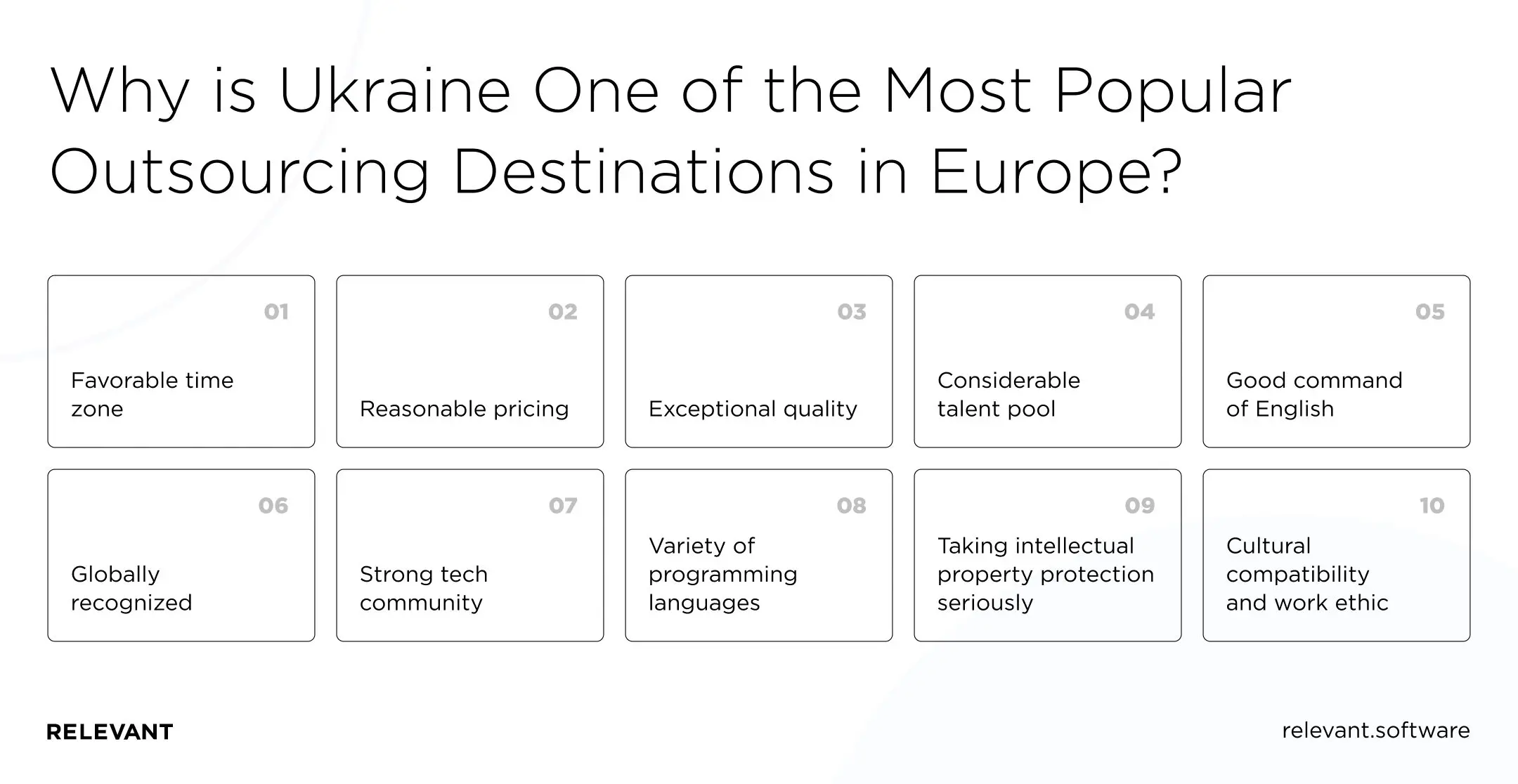
Favorable Time Zone
Ukraine is located in the Eastern European time zone, which is only 1-2 hours ahead of most European countries and seven hours ahead of the East Coast. Because of the convenient time zone overlap, Western European and US-based businesses can easily collaborate with Ukrainian teams.
Reasonable Pricing
Hiring software developers in Ukraine, based on outstaffing or dedicated software development team business models, is a more cost-efficient option than hiring Americans or Western Europeans for the same job. The average hourly rates of Ukrainian programmers range from $25 to $80, depending on their seniority, skills, English proficiency, and competencies.
Exceptional Quality
Ukrainian programmers are known for providing world-class software development services and are recognized by many industry rating platforms. For example, HackerRank rates Ukraine higher than the UK or the US in the global ranking of the best developers worldwide. For AI-heavy builds, you can even bring on Claude-certified architects who design around large language models.
Considerable Talent Pool
Today, Ukraine has more than 300,000 IT specialists, and that number keeps growing. Over 25,000 tech graduates enter the Ukrainian IT market each year, and the quality of Ukrainian engineering education is also exceptionally high.
Good Command of English
Besides solid technical expertise, Ukrainian IT professionals have a good command of English. Most developers speak English at an intermediate level or higher. In the 2025 EF English Proficiency Index, Ukraine ranks 45th out of 100+ countries and regions, inside the high-proficiency band.
Globally Recognized
Ukraine holds the top spot in many international rankings related to the IT industry. For example, Ukraine ranks first in the Science and Technology category of The Good Country Index and in the Outsourcing Market in Eastern Europe ranking. Also, many global tech giants like Microsoft, Oracle, Huawei, and Samsung have established their R&D centers here.
Strong Tech Community
Ukraine frequently hosts the largest European tech events, including The Agile Eastern Europe Conference, Lviv IT Arena, and DEV_Challenge. There are also a significant number of IT clusters and communities that hold regular meetups and conferences.
Variety of Programming Languages
Ukrainian developers are proficient with cutting-edge technologies, including JavaScript, Node.js, Python, Ruby, and PHP, so you can hire web developers with the exact stack you need.
They are also well-versed in AI, VR/AR, and IoT, which makes it easy to bring on mobile app developers or niche specialists for a particular product. That is why startups looking for a specific tech skill set frequently consider Ukraine as their outsourcing destination.
Taking Intellectual Property Protection Seriously
Cooperation with Ukrainian companies usually starts with signing an NDA to ensure the confidentiality of the sensitive information you share during your project’s development. Further down the line, your project may need to meet international security requirements such as ISO, HIPAA, or PCI. Ukrainian software developers will be able to help you stay legally compliant as well.
Cultural Compatibility and Work Ethic
Ukrainian developers are generally open-minded and communicative, have a strong work ethic, and share Western culture and values. They mainly choose a career in the IT sector because of their passion for technology. In addition, they are hard-working and eager to learn.
Main Software Development Cities of Ukraine: Kyiv, Kharkiv, Lviv, Dnipro, and Odesa
The Ukrainian IT industry is flourishing with an ever-growing number of new software development companies and startups. Kyiv, Kharkiv, Lviv, Dnipro, and Odesa have powerful IT clusters and are the top five centers where the vast majority of tech talent concentrate. Here is a brief overview of these cities.
Kyiv
Kyiv, the capital of Ukraine, is one of the top 35 most developed urban startup ecosystems. It houses the largest IT talent pool in the country as well as world-known tech universities; there are a lot of coworking spaces, plenty of professional communities, and the world’s tech giants’ R&D centers.
Kharkiv
Being the second-largest city in Ukraine, Kharkiv is home to more than 450 IT companies with over 25,000 specialists. Kharkiv has over 3,000 IT students graduating each year, and its IT сluster is constantly growing. Kharkiv is also the birthplace of GitLab, the first Ukrainian unicorn.
Lviv
Lviv is another major tech hub in Ukraine. It is home to around 460 IT companies, most of which provide software outsourcing services to the US, the UK, and Western Europe. In 2019, the Lviv IT industry’s overall economic impact exceeded $1 billion. With around 26,500 tech professionals and a 45% growth rate for IT companies, Lviv has every chance of outperforming Kyiv in terms of tech talent. This city also hosts the largest tech event in Eastern Europe, Lviv IT Arena, taking place in September.
Dnipro
Dnipro is the fourth-largest IT destination regarding the number of IT specialists, and it has the second-largest number of R&D centers in Ukraine. In addition, the city is home to many international companies, including Playtika, WIX, Healthjoy, CandyGrill, and Techery. Dnipro has around 13,200 IT professionals and holds 7.9% of all Ukrainian IT resources.
Odesa
Odesa is one of the fastest-growing Ukrainian startup hubs. It is home to around 150 IT companies from various industries—from automotive, cybersecurity, and AR to big data and mobile development. The city can also boast of being home to Looksery, the startup purchased by Snapchat for $150 million.
So, there are several leading cities to hire Ukrainian developers. Now, let’s find out how to hire software developers in Ukraine.
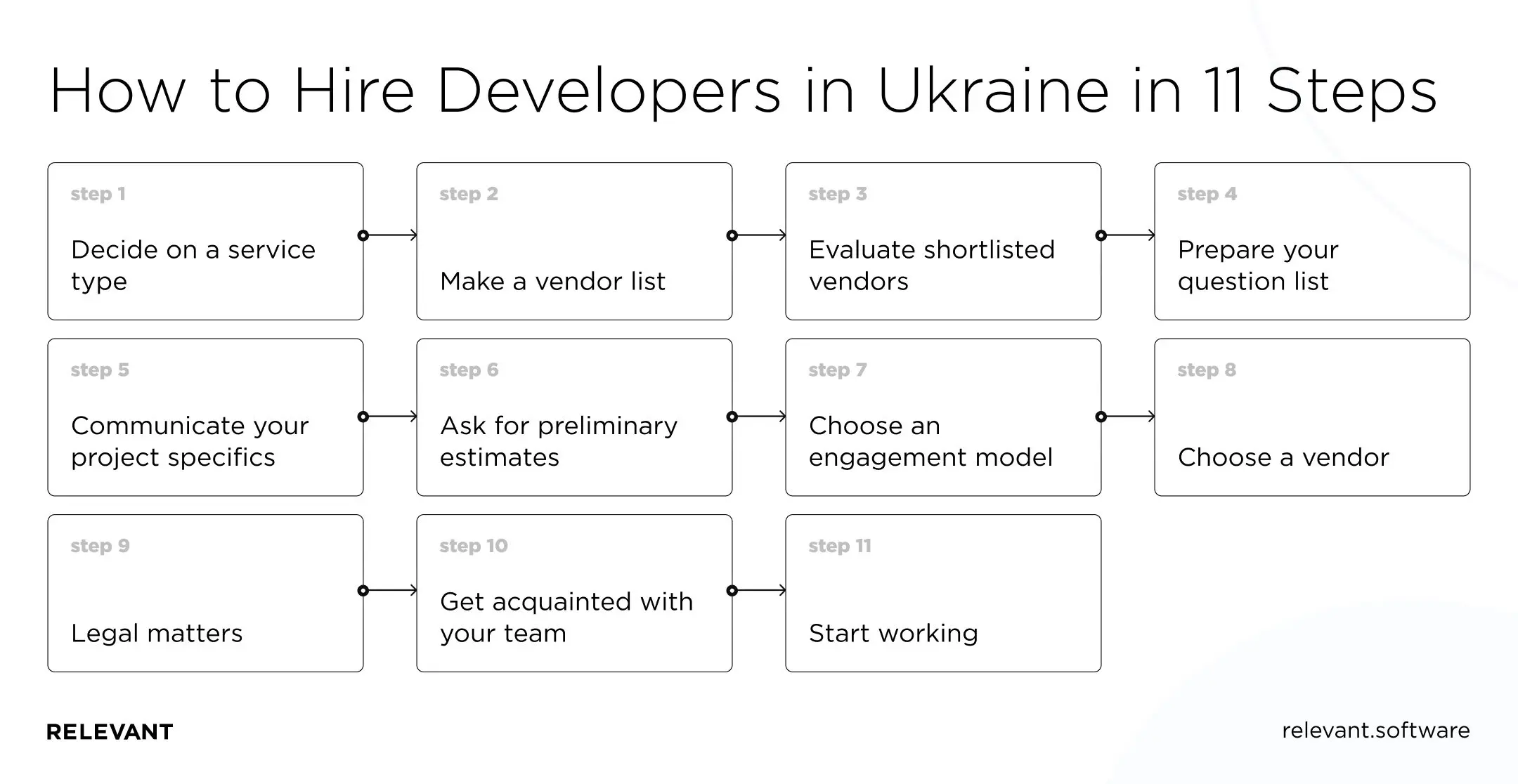
How to Hire Ukrainian Developers in 11 Steps
Gathering a value-driving development team can be challenging while getting lost in the opportunities the Ukrainian IT market offers is quite easy. Below is a step-by-step guide to hiring Ukrainian developers in the smartest way possible.
Step 1. Decide on a Service Type
The first step to hiring Ukrainian developers is to decide on the engagement model that matches your project goals best. There are three options to choose from:
- IT outstaffing in Ukraine. This service means hiring remote developers in Ukraine to scale your in-house tech team and better cope with additional workload or effectively address talent shortages.
- hiring a dedicated development team in Ukraine. This development model means gathering a cross-functional team to create a software project from scratch.
- Software development outsourcing for web or mobile development with Ukrainian teams. Software development outsourcing means hiring a team according to a Fixed price model, Time and Material (T&M) model, or dedicated development contracts depending on your business needs and project specifics.
When making this decision, you have to carefully analyze your business goals, project specifics, growth opportunities, and management requirements. As an option, get in touch with Relevant for a quick consultation.
Step 2. Make a Vendors’ List
Once you decide on a service type, start researching trusted resources like Clutch or GoodFirms to compare the companies by size, location, expertise, hourly rate, and customer feedback. Asking for a recommendation from your colleagues and partners is also worth trying. Next, shortlist 5 to 10 vendors you feel could be a good fit for your project.
Step 3. Evaluate Shortlisted Vendors
At this stage, dig into each shortlisted vendor’s website, case studies, and review profiles to understand how they actually work. A polished homepage tells you little, so look for evidence of delivery. Check whether they have shipped products like yours, whether they can hire a full-stack developer or staff a whole cross-functional team, and how openly they describe their process. Focus on three things:
- The technologies and platforms their teams know best, and how current that stack is
- How they run development and project management, from sprint cadence to reporting and QA
- The results in their portfolio, including measurable outcomes and client references you can verify
Step 4. Prepare Your Question List
Now, it’s time to get in touch with your shortlisted vendors. Your email can include questions about their rates and the way they handle confidential information, requests for referrals, or information about some projects in their portfolio. You can also ask a vendor to sign an NDA prior to sharing any of your project specifics.
Step 5. Communicate Your Project Specifics
Once you have received their answers, it’s time to schedule calls and speak with the shortlisted vendors. During a call, you can share some of your project specifics, communicate your values, and ensure that they align with a vendor’s values. When your outsourcing company understands your mission and has the same project vision, it becomes your trusted partner and invests in your company’s growth.
Step 6. Ask for Preliminary Estimates
Before going too far, ask each shortlisted vendor for a preliminary estimate or at least a realistic price range for your scope. A good vendor will explain what drives the number, which parts are fixed, and which depend on decisions you have not made yet.
Ask directly about anything that could inflate the bill later, such as onboarding time, rate changes as the team scales, third-party licenses, or overtime during crunch. Comparing estimates side by side also shows you who understands the work and who is guessing.
Step 7. Choose an Engagement Model
Sharing a vision for a project, discussing the ins and outs, and agreeing on the scope are all crucial for successful cooperation. However, there is one more aspect that is equally important: choosing an engagement model (e.g., fixed price, T&M, or a dedicated team). Choosing the model will impact your total project budget.
- A fixed price contract, as the name suggests, means you have to pay a pre-discussed amount for a certain amount of work. Usually, small-to-medium projects with a highly predictable development path choose this type of contract.
- A Time and Material contract, in turn, is a choice for projects with low to no predictability. For example, this model is a good choice for data migration or legacy system modernization since you can never know what technical surprises the legacy code has.
- A dedicated development contract is the most expensive one. Usually, companies in need of cross-functional development talent choose it. This type of contract makes the most sense for large projects with ambitious scalability goals.
Step 8. Choose a Vendor
When choosing a vendor, take into account not only the facts you’ve gathered (e.g., tech stack, estimations, engagement models) but also the way a company communicates.
Whether you want to outsource software development, hire Ukrainian developers, or find engineers to expand your in-house team, communication culture is a vital part of any partnership. Sometimes a vendor can seem like the perfect choice, but it takes them a couple of days to respond to your messages, and your collaboration is unlikely to run smoothly. In this case, it would be better to choose another vendor.
Step 9. Legal Matters
All trustworthy Ukrainian software development companies work legally. So once you’ve chosen a vendor, you need to sign a contract and agree on the payment schedule based on the engagement model you chose.
Privacy and data security are other important issues to keep in mind, so you can never be too cautious about addressing them appropriately. Apart from signing a non-disclosure agreement, ensure the company follows modern security standards and conducts regular audits to protect all your sensitive data.
Step 10. Meet Your Team
When all these things are set, it’s time to get acquainted with your team. Communicate your priorities and agree on the working process, meeting schedule, deliverables, and other important matters. Just like hiring in-house team members, outsourced staff also require an onboarding process, so don’t forget to introduce your toolset and the in-house team members developers will work with.
Step 11. Start Working
It is always exciting to start a new project and watch it grow from the first commit to a working prototype and then a full product. To keep that momentum, set clear milestones, agree on how progress is reported, and review demos at the end of each sprint.
Give feedback early and often, listen to your team’s technical suggestions, and keep decisions moving so nobody sits blocked. The teams that get the most from Ukrainian developers treat them as partners, share context freely, and adjust scope as they learn what users need.
Hiring a Development Team in Ukraine: Terms and Options
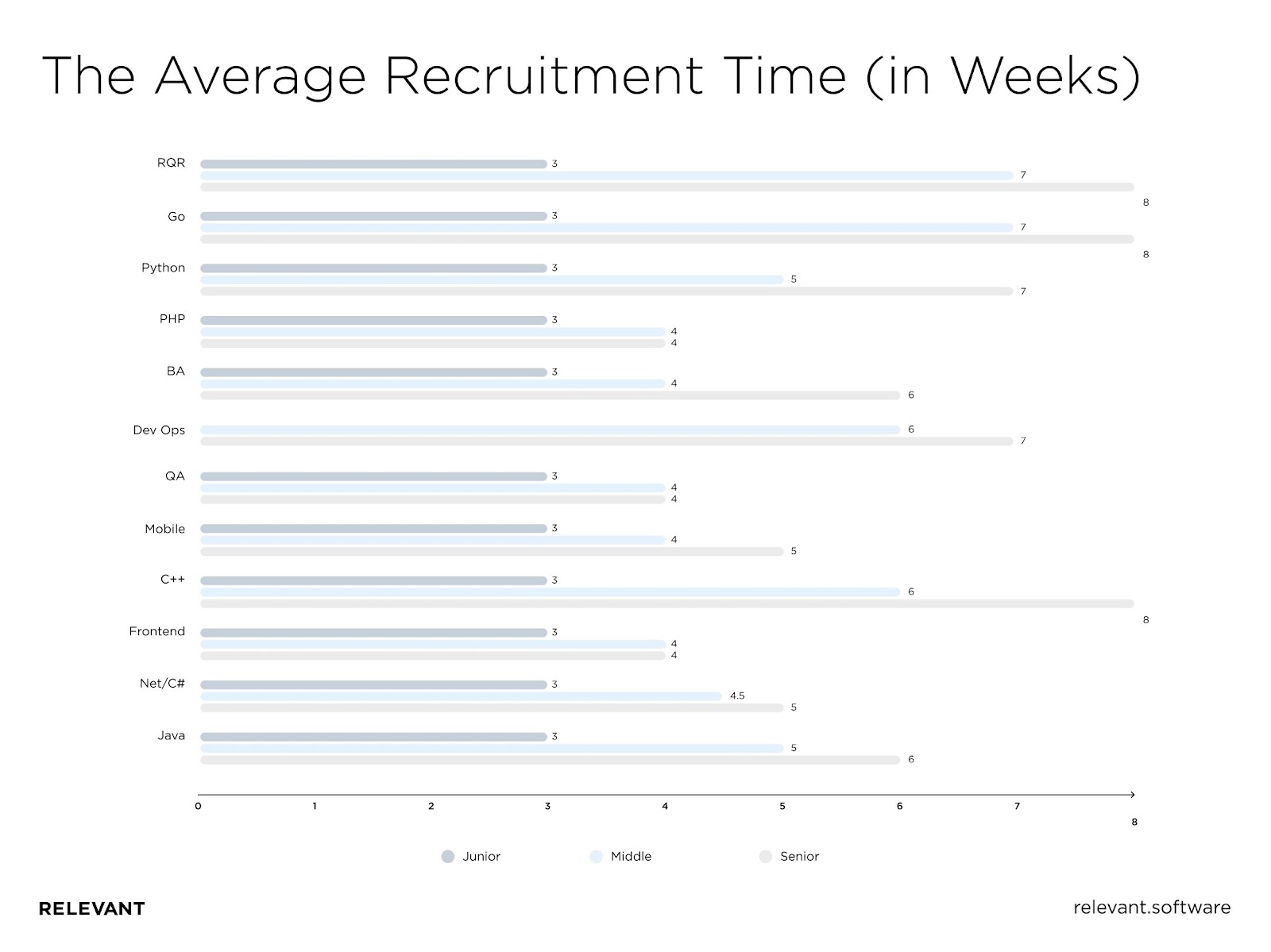
It may seem that hiring a freelancer is easier than partnering with a vendor, and it will take all the burden off your shoulders. But that’s never the case. Finding a perfect fit isn’t always fast and easy—actually, the average time to hire a software engineer can vary from 3+ weeks for junior specialists to 6+ weeks for seniors.
If you have a pressing deadline or just need a reliable vendor, hire a trustworthy development company rather than an individual developer. Here are the benefits an outsourcing vendor can offer:
- Extensive talent pool. If the tech company has available developers on board, you can interview them instantly and start working in the shortest possible time. If your project needs specific tech talent, your development vendor will be able to source the right candidates as well.
- Risk mitigation. When working with an outsourcing software development company, you don’t have to worry about legal compliance, project management and work progress tracking, transparent billing, and payroll.
- Simplified scaling. If you need to scale the team during a development process, an outsourcing company can help you do that very quickly.
Leaving the hiring process to a software development team is the right choice. In addition to saving time, it is also cost-effective. Let’s take a closer look at the cost of outsourcing to Ukraine.
Software Development Rates in Ukraine
The cost of project development is one of the key considerations when choosing a software vendor. Competitive software developers’ rates make Ukraine one of the most popular software development destinations. Let’s research the numbers.
Hiring an experienced developer in the US can cost you, on average, $100 to $150 per hour. If you decide to hire dedicated developers in Eastern Europe, the hourly rate to hire them will be more competitive without compromising the quality of the final product. Hourly rates in Ukraine range from $25 to $80. Such a cost-effective opportunity is especially promising if you have a tight budget.
Like anywhere else in the world, the exact rates of Ukrainian developers will depend heavily on their area of expertise, technology, and seniority level. To help you get an idea of possible pricing, we’ve made a table listing roles and corresponding rate breakdowns.
| Role | Rate |
| Business analyst | $40-$63 |
| Architect | $50-$77 |
| Project manager | $45-$70 |
| Junior engineer | $25-$42 |
| Middle engineer | $35-$60 |
| Senior engineer | $55-$90 |
| Junior QA | $25-$42 |
| Middle QA | $30-$49 |
| Senior QA | $40-$63 |
| UI/UX designer | $35-$56 |
Challenges When You Hire Developers in Ukraine
Ukraine has a vibrant tech community, thousands of talented professionals, and a fast-growing IT ecosystem. Still, most business owners are concerned about software outsourcing challenges or roadblocks that could appear along the way. So, let’s discuss the ones you should keep in mind when cooperating with Ukrainian IT companies.
Government Regulations
Sometimes, a country’s laws regarding outsourcing stand in the way of successful cooperation between local providers and foreign clients. The Ukrainian government, in turn, creates all the conditions to drive the IT industry. It supports and stimulates its development by adopting reforms and laws, such as a simplified tax regime for IT professionals. Ukraine has had its tough times, but political events have never negatively influenced the government’s attitude toward the IT industry.
Legal Aspects
Developing software projects implies sharing intellectual property and exchanging large amounts of money. When you hire a development team in Ukraine, you may have concerns about being legally unprotected. A reliable Ukrainian software development company will offer to sign the following three outsourcing software development documents that will secure you:
- Software requirements specification (SRS) document. This document’s main purpose is to describe how your software will be developed and how it should function. The SRS includes definitions for the functional and non-functional specifications of the software, along with use cases.
- A Non-Disclosure Agreement (NDA). This is an agreement between your company and the vendor aimed at protecting confidential information disclosed during the development process. The main provisions should include the definition of confidential information, exceptions to the concept of “confidential information,” obligations, terms, and remedies.
- Statement Of Work (SOW). This document covers every critical aspect of your cooperation. It should clarify every point of your agreement, such as terms, schedules, payment methods, work standards, and delivery acceptance criteria.
Resilience Through Disruption
Through the pandemic and the full-scale war, Ukraine’s IT sector has kept delivering. Companies moved to distributed, remote-first work and maintained continuity, while IT services exports have stayed at multi-billion-dollar levels. Remote delivery has proven just as effective as in-office work.
Success Stories of Hiring Ukrainian Developers
Grammarly, Readdle, Looksery, MacPaw, and Depositphotos have one thing in common—all of them are of Ukrainian origin. There are also other less-known but no less successful projects created in Ukraine, so let’s take a closer look at some of them and discover the stories behind their creation.
Airthings
Airthings is a Norwegian tech company. They have been producing indoor radon monitoring solutions for more than a decade. However, they lacked real-time collection, processing, and visualization of data from their IoT devices.
The company contacted Relevant to help them tackle performance issues and solve the user’s problems. After a round of brainstorming and discussion about the required feature set, our engineers created a new dashboard on the Airthings website that connects all devices and can be customized according to a user’s preferences.
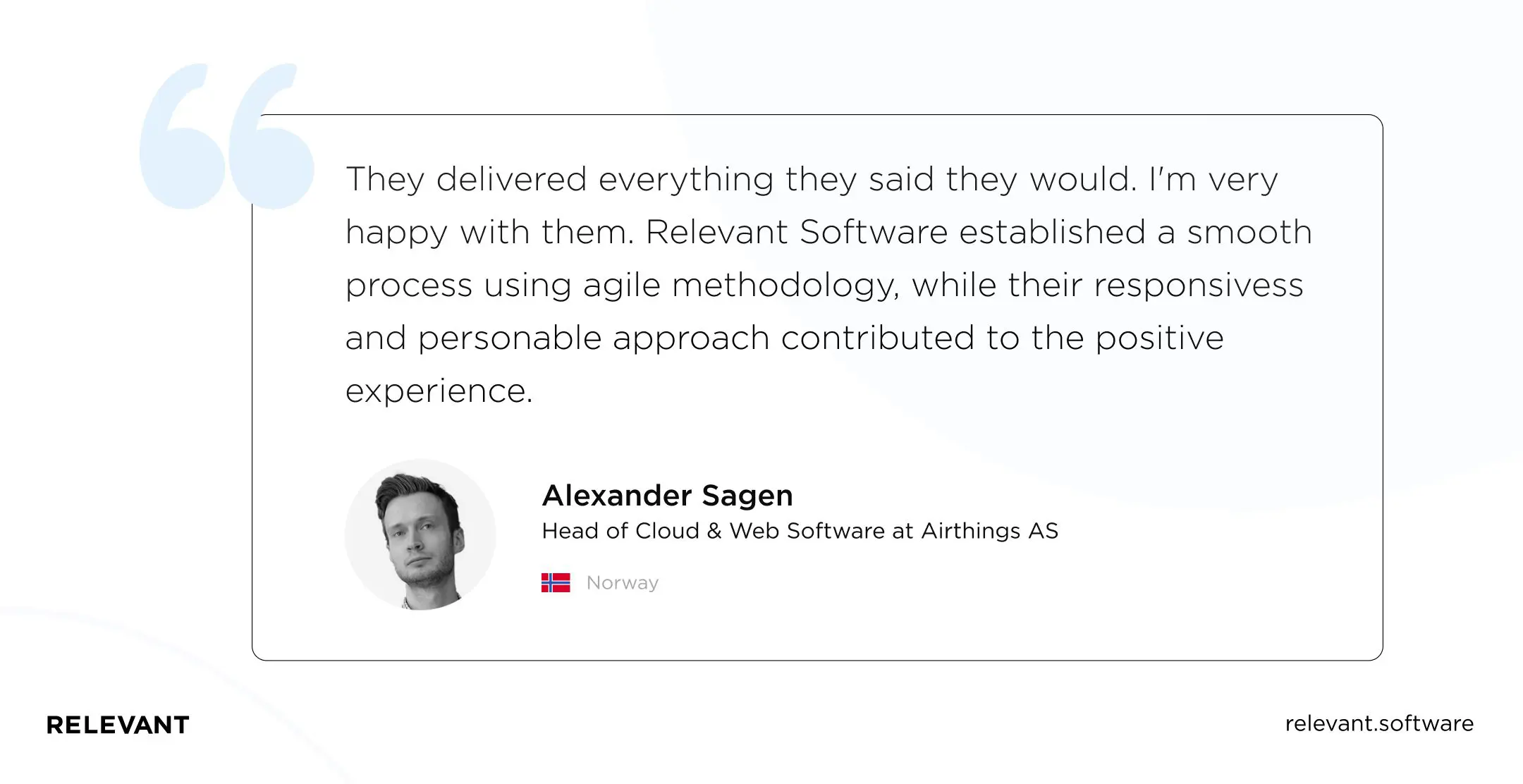
To decrease load times and improve rendering speed, developers used the clustering approach. It positively impacted rendering speed and helped display a map that shows the location of and data from each device without any delays. Alexander Sagen, Head of Cloud & Web Software at Airthings AS, was delighted with the quality of Relevant’s services and left positive feedback. Here’s what he said:
Biderator
Biderator is an auction platform for the construction sector. It connects contractors to clients and provides them with a transparent bidding process.
A client with over 20 years of experience wanted to develop Biderator to solve the everyday challenges of the construction businesses, so they sent Relevant a request. Despite the time zone gap, our team managed to set up a comfortable and collaborative environment.
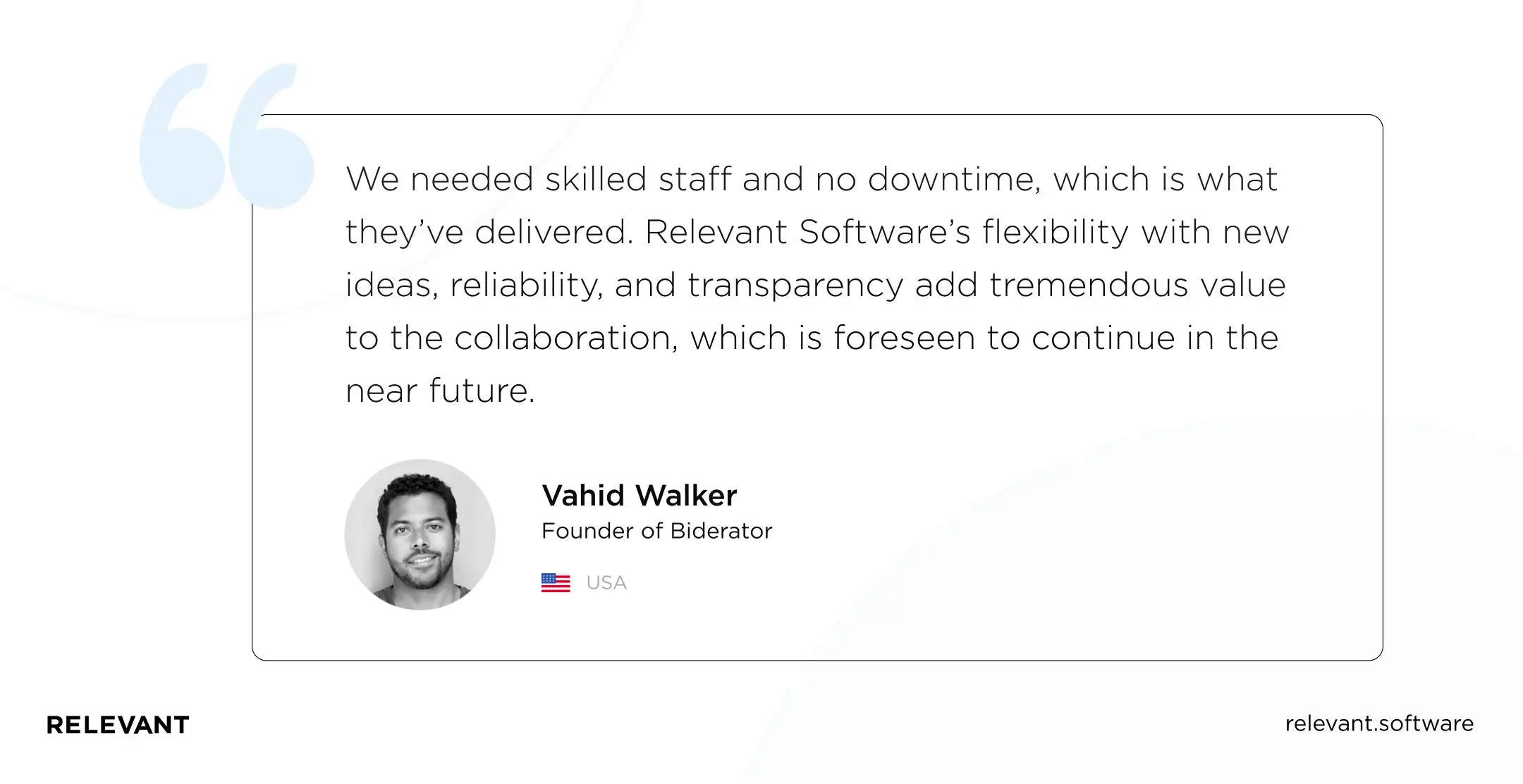
Since there were multiple stakeholders, we used modern facilitation techniques and old-school methods (e.g., the RACI matrix). Once the feature set was discussed and agreed upon, our engineers designed the architecture and developed the web application using progressive programming languages—Angular on the front end and Node.js on the back end. As a result, Relevant contributed their efforts to the website development process, which made Vahid Walker, CEO, and Founder of Biderator, hope to collaborate with our team in the future. Here’s what he thinks about our cooperation in general:
Summary
Reasonable software development rates, a considerable talent pool, and highly experienced engineers are only a few reasons why Ukraine ranks among the best countries to outsource software development.
If you have already decided to hire software developers in Ukraine, your next step should be finding a qualified tech partner. When choosing an outsourcing provider, pay attention to their expertise, experience, customer reviews, and completed projects.
Relevant has been operating worldwide for over 13 years, helping businesses and startups scale their engineering teams and build the right products cost-efficiently. We have 200+ projects under our belt and can implement the most challenging outsourcing tasks. So if you need a skilled software development team, contact us, and we’ll be happy to help.
FAQ
How much does it cost to hire Ukrainian developers in 2026?
Rates depend on seniority, tech stack, and English level, but Ukraine stays well below US and Western European prices. Most engineers bill between $25 and $80 an hour, roughly two to three times cheaper than comparable US talent. Typical ranges look like this:• Junior engineer: $25 to $42 an hour
• Middle engineer: $35 to $60 an hour
• Senior engineer: $55 to $90 an hour
• QA and design roles: $25 to $63 an hour
For a full-time dedicated developer, that works out to roughly $4,000 to $10,000 a month. Always confirm what the rate includes, since management, QA, and infrastructure are sometimes billed separately.
How long does it take to hire a development team in Ukraine?
Timelines depend on how senior and specialized your team needs to be. With an established vendor that keeps engineers on the bench, hiring moves fast, while building a niche team from scratch takes longer.• Outstaffing a single developer: a few days to two weeks
• A small dedicated team: two to four weeks
• A senior or niche-heavy team: three to six weeks or more
Freelance hiring can feel quicker at first, but vetting, contracts, and onboarding often stretch it out. A vendor handles sourcing, screening, and paperwork in parallel, so you usually start sooner and with less risk on your side.
What is the difference between outstaffing and a dedicated team?
Both models give you Ukrainian talent, but the control and structure differ. The right choice depends on whether you already have a team and processes in place.• Outstaffing adds individual developers to your in-house team, and you manage them day to day
• A dedicated team is a self-managed, cross-functional group that owns delivery under its own lead
• Outstaffing suits filling specific skill gaps quickly
• A dedicated team suits building and running a product end to end
Outstaffing gives you the most direct control, while a dedicated team offloads coordination and hiring. Many companies start with outstaffing and grow into a dedicated team as the scope expands.
Which technologies do Ukrainian developers specialize in?
Ukraine has deep talent across both mainstream commercial stacks and newer specialties, so most projects can be staffed locally.• Web and backend: JavaScript, TypeScript, Node.js, React, Python, Java, .NET, Go, PHP, Ruby
• Mobile: Swift, Kotlin, React Native, Flutter
• Data and AI: machine learning, data engineering, and large language model work
• Cloud and infrastructure: AWS, Azure, Google Cloud, and DevOps
Teams also work in VR/AR and IoT, which is why product companies with specific requirements shortlist Ukraine.
How do I protect my intellectual property when hiring in Ukraine?
Ukrainian vendors take IP protection seriously, and cooperation usually starts before any code is written. You secure your rights through a few standard documents.• A Non-Disclosure Agreement that defines confidential information and how it is handled
• A Statement of Work that sets scope, terms, and acceptance criteria
• A contract that assigns all IP and source code to you
Reputable companies also follow security standards such as ISO, and many can meet HIPAA or PCI requirements when your project needs them. Confirm that IP assignment is explicit in the contract, and that the vendor runs regular security audits to keep your data safe.
What time zone do Ukrainian developers work in?
Ukraine sits in Eastern European Time, one to two hours ahead of most of Western Europe and about seven hours ahead of the US East Coast. That gives you a full working-day overlap with European teams and a solid morning overlap with the US, which is enough for daily standups and quick decisions.Many Ukrainian developers also shift their hours to match clients further west, so real-time collaboration rarely becomes a problem. When you plan the working relationship, agree on a few fixed hours of overlap for meetings and keep the rest asynchronous. That balance keeps everyone productive without forcing anyone into permanent night shifts.


