


IoT in the Workplace: Benefits, Challenges, Applications and Much More
 Andrew BurakCEO and Founder at Relevant Software
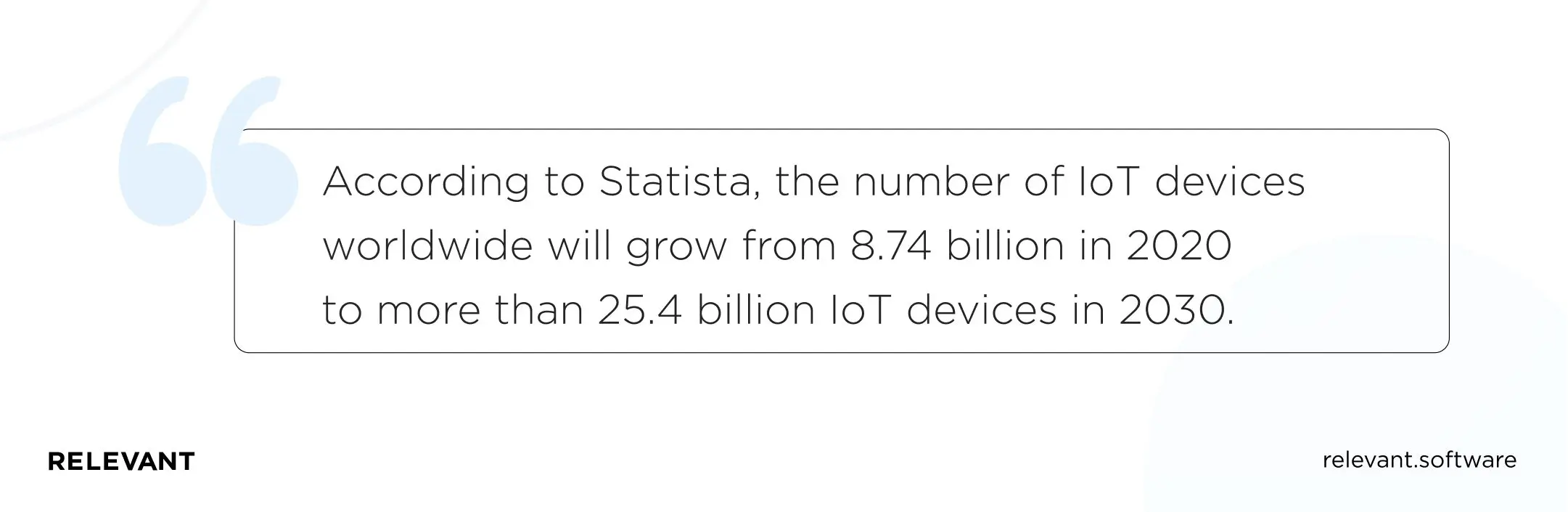
The internet of things keeps reshaping how we live and work. Smart cups, intelligent lighting, IoT-enabled desks, occupancy sensors, and connected HVAC now sit inside everyday offices. The scale behind this shift is large. IoT Analytics counted 21.1 billion connected IoT devices at the end of 2025, growing about 14% year over year, and expects the base to reach 39 billion by 2030.
For businesses, that connectivity created the workplace of the future known as the smart office. In 2026, hybrid schedules make each desk and meeting room harder to predict, energy bills stay under pressure, and leaders want real data on how space gets used. IoT answers those questions with live signals instead of guesswork. This guide covers the benefits, the challenges, and the real applications of IoT in the workplace, and it helps you decide whether a smart office fits your company. If you plan to build one, our IoT development services can help.
How is the Internet of Things transforming workplaces?
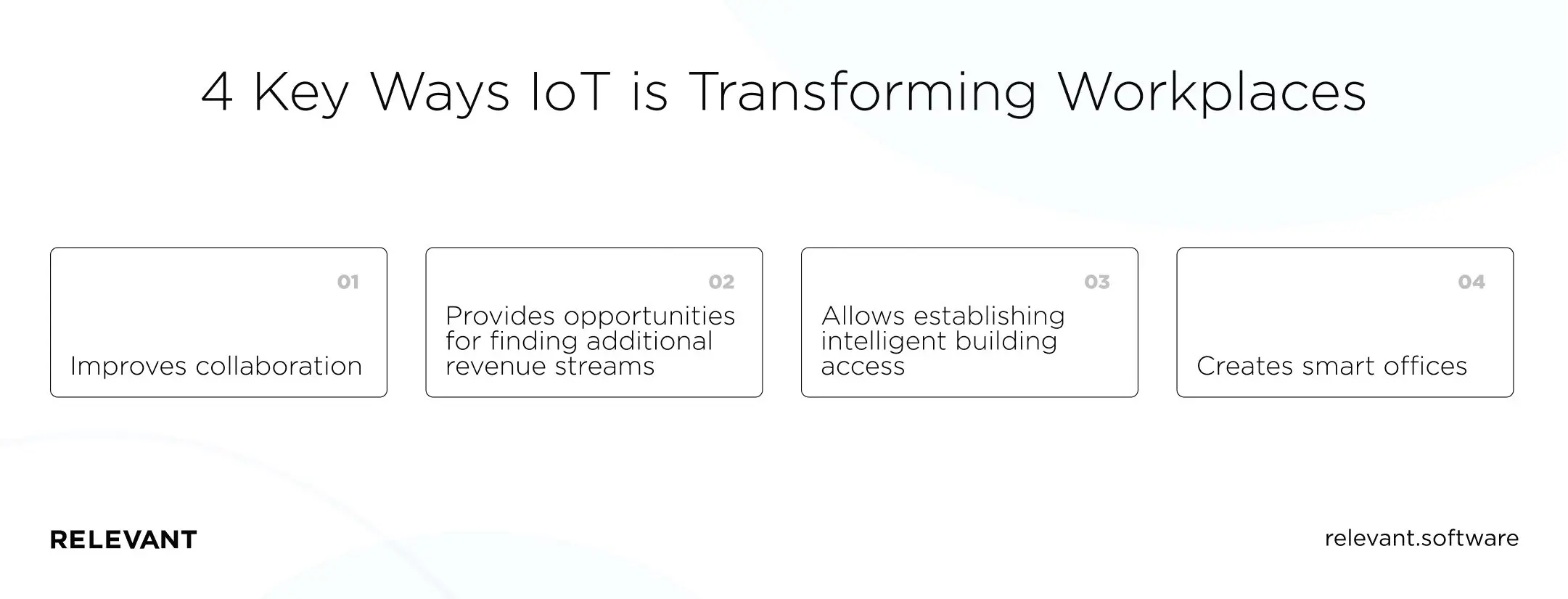
Here are some ways IoT is changing how companies manage their work and employees:
Improving collaboration
Hybrid work is now the default at many companies. Teams split their week between home and office, so they need stronger support and better collaboration across locations. Standard video conferencing covers part of the gap. Workplace IoT technology goes further.
Telepresence robots such as Double Robotics’ Double 3 and Ava Robotics’ Ava improve on the static video call. A computer sits on top of the robot and gives the caller a real presence in the room.
With this technology, professionals interact with on-site teams, move around without a guide, and tour facilities anywhere in the world with a few clicks. Immersive tools like augmented reality add true-to-life experiences, so users can test products or rehearse dangerous scenarios from a remote location.
Opportunities for finding additional revenue streams
IoT big data solutions changed how businesses operate across industries. Sensors and connected devices collect large data sets on customer behavior, product performance, and more. Wearables like Fitbit track how people sleep, eat, move, and exercise. The insights help companies improve products and services to match what customers need. Operational data helps them streamline daily and long-term activities.
Beyond improvements, IoT data helps businesses spot patterns and new growth opportunities. That might mean a fresh segment for an existing product or an entry point into a profitable market.
Establishing intelligent building access
Access control systems give a convenient, secure way into facilities. Connected devices such as locks, card readers, and biometric systems each carry a unique IP address and communicate with one another. They let workers enter buildings or offices without a plastic ID while keeping intruders out.
In most organizations, employees reach a facility through connected IoT mobile apps using a digital ID. The system tracks the time and access level of each user. Any malicious activity triggers an alert on authorized devices, and you can issue instructions from there. This protects employees and company assets.
Creating smart offices
Successful use of the internet of things at work leads to smart offices. These devices help businesses improve day-to-day operations. Examples include Wi-Fi scanners that copy and send documents to tablets and computers, smart sensors that adjust temperature and lighting, and indoor wayfinders.
A later section covers more IoT smart office solutions in depth.
Smart Offices: Hype or necessity?
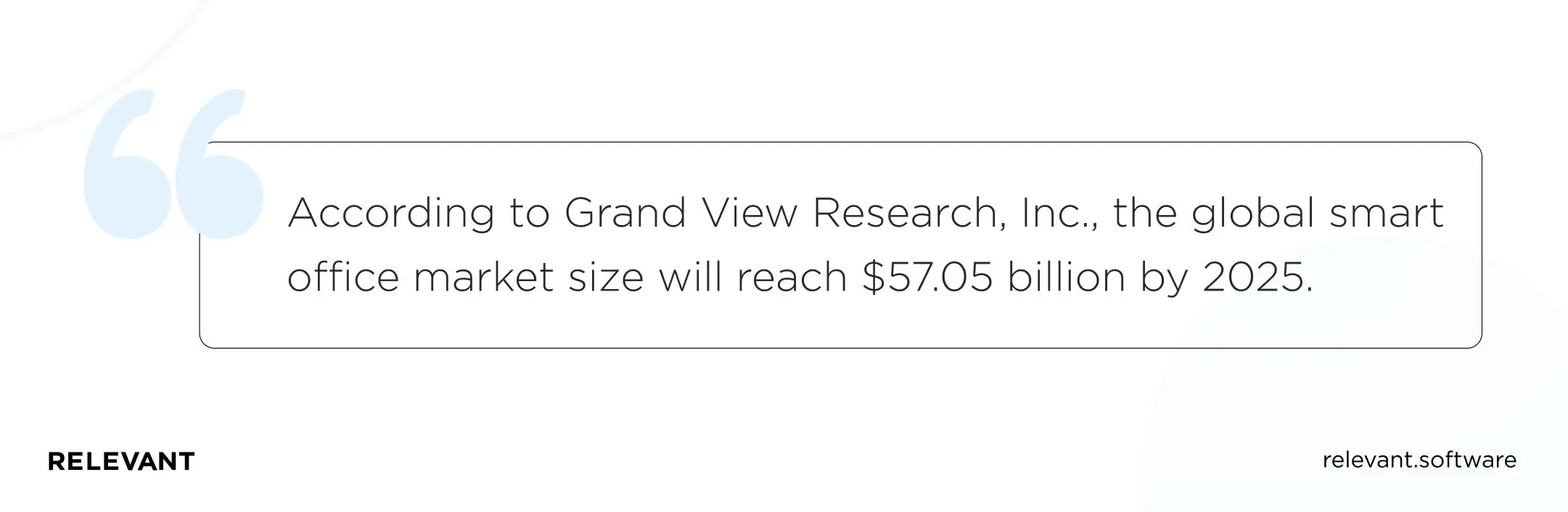
Smart offices are on the rise. According to Grand View Research, Inc., the global smart office market was worth $53.9 billion in 2024. The firm expects it to grow at a 13.9% CAGR from 2025 and reach $113.8 billion by 2030. The main drivers are advances in IoT, hybrid work, and the push for more sustainable use of IT resources.
More companies now adopt IoT for smart offices to get the best from their employees, resources, and cross-team collaboration. The projections and the results businesses report show that these solutions are moving from optional to standard.
Before we cover the benefits, what is a smart office and how does it work?
What is meant by a Smart Office?
A smart office is a workplace that uses technology to improve the employee experience, boost efficiency, and lift business performance. The technology includes software, cloud-based services, and hardware such as security systems, smart lighting and controls, and HVAC control systems.
How Smart Office works and the role of IoT in it
Often called the future workplace, the smart office is built to promote interaction among connected teams and enable a faster, better way of doing business. Several devices and technologies work together to improve the workplace experience. As with most digital transformations, IoT drives the process.
A smart office system uses IoT sensors to exchange data with connected devices. With that data, companies adjust the work environment, improve collaboration, and find cost-saving opportunities.
Smart window blinds track the position of the sun and adjust to shield workers from glare. Security cameras stream to connected devices and give users a live view of the workplace from anywhere.
IoT and office automation: Benefits and challenges
Here are the main advantages of smart offices, along with the issues that come with IoT in the workplace.
The advantages of Smart Offices
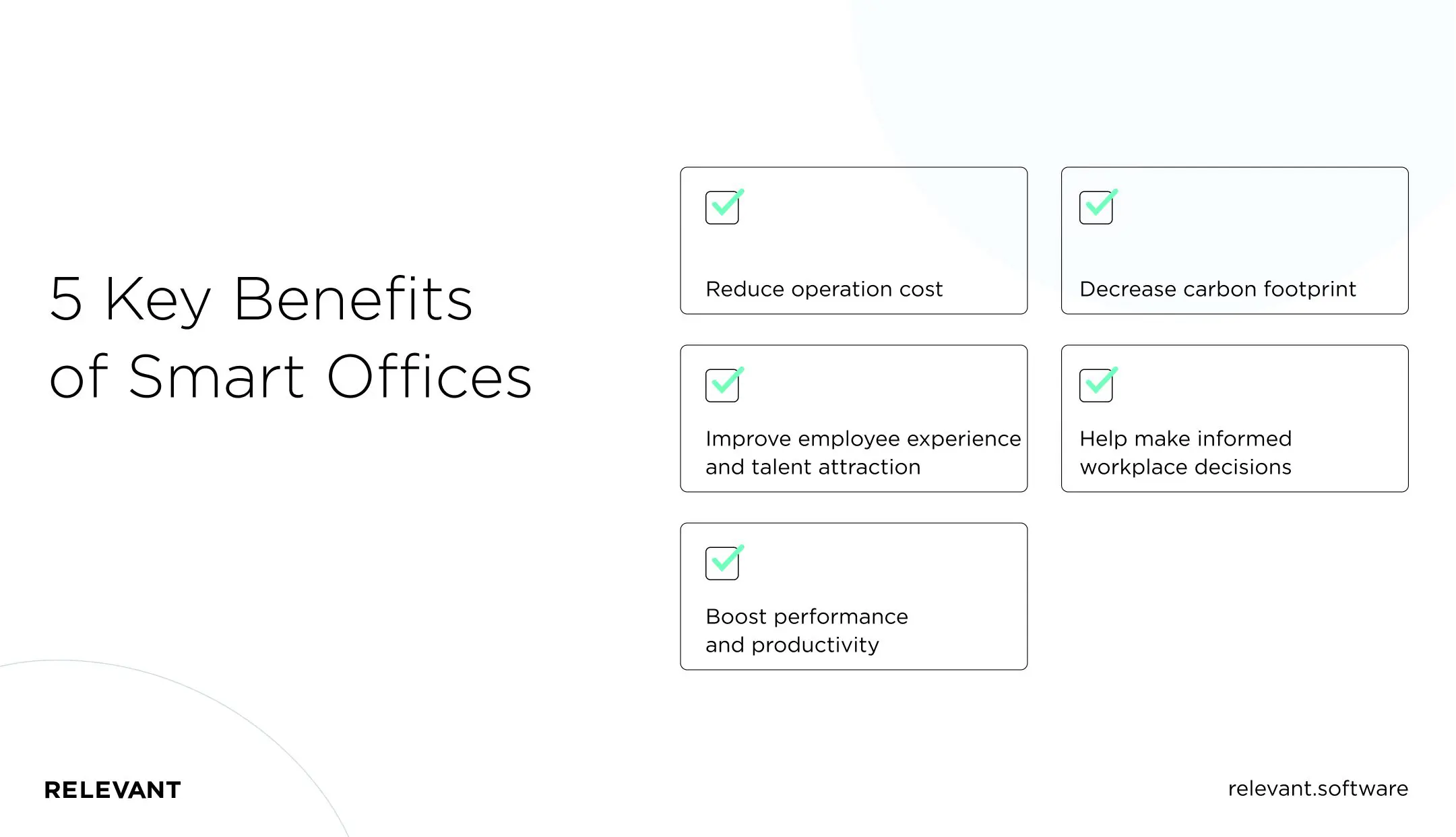
Here is the value smart offices bring to organizations:
- Reduce operation costs. Smart office solutions help companies cut costs in several areas. Sensors capture real-time occupancy to optimize energy use. This solves overheating, insufficient heating, excess lighting, and other waste. Occupancy data also helps companies right-size their space and cut rent. With sensor-based predictive maintenance, businesses schedule fixes at the best time and avoid downtime. Together, these cuts add up across facilities.
- Improve employee experience and talent attraction. A smart office creates a better working environment that supports daily work. Employees use technology to simplify tasks and handle repetitive work. They also work in comfortable conditions, which keeps them happy and engaged. In recruitment, a smart office appeals to modern workers and can draw in strong candidates who might not have considered your company.
- Boost performance and productivity. A connected workplace optimizes workflows. IoT devices remove the physical barriers that slow people down. Employees join meetings from anywhere. High-speed networks cut latency, so access and transactions run smoothly. With cloud-based tools, remote teams collaborate with on-site staff and speed up projects across locations. Indoor wayfinding apps help workers navigate unfamiliar facilities in less time.
Several smart office automation solutions scale processes such as admin tasks, product design and delivery, and procurement. This lifts efficiency and productivity at every level. - Decrease carbon footprint. Smart offices adopt sustainable practices that help fight climate change. Companies use sensors to optimize energy use in buildings. Collaboration tools cut business travel and commutes, which lowers CO2 emissions from transport. Smart waste management systems sort waste to reduce non-degradable material going to landfill. These practices shrink an organization’s ecological footprint.
- Make informed workplace decisions. As a company grows, so do employee needs. Instead of relying on assumptions, companies use IoT data to anticipate those needs and decide with facts. They learn how workers use facilities, peak working hours, dead zones, and the most-used equipment. That information helps them roll out solutions that match how the workplace actually runs.
Concerns about Smart Offices
IoT-enabled offices offer real benefits to organizations of all sizes, but adoption brings concerns. Here are the main problems.
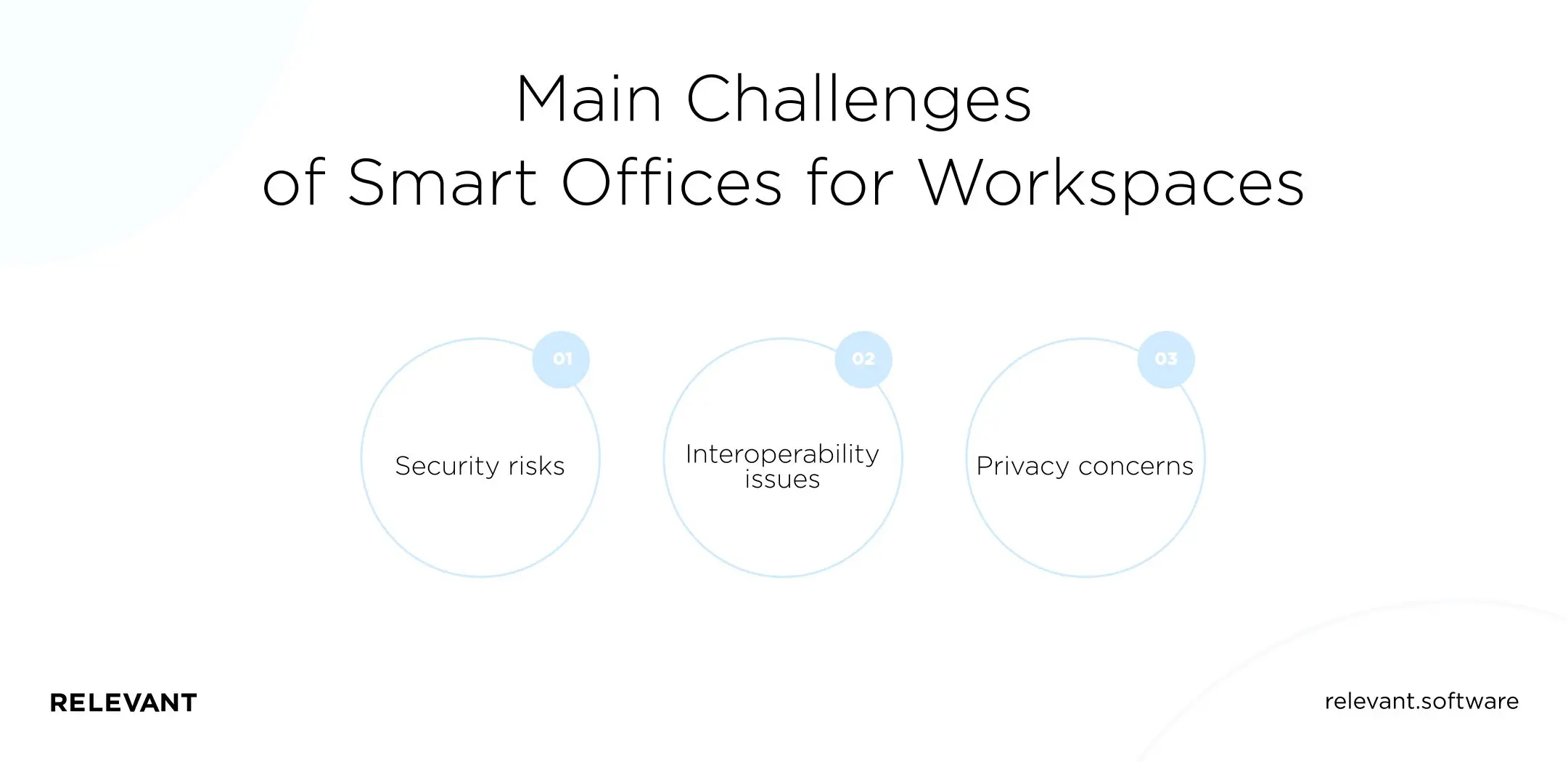
- Security risks. Weak security is a common problem for IoT and any smart office built on it. To reach the market fast, some manufacturers pay less attention to device security. They ship inconsistent updates and reuse a default password across a whole model line, and end users rarely change it. In 2016, attackers used compromised webcams and digital recorders to knock Twitter, PayPal, Spotify, and other platforms offline. They exploited weak devices and default passwords set by the manufacturer. A breach can cost an organization trade secrets and other sensitive data.
- Interoperability issues. IoT runs as an ecosystem of cloud gateways, hardware, sensors, and software that communicate as one network. No single technology delivers the full experience alone. The spread of proprietary enterprise IoT products created problems here. Many vendors build products that only work with their own hardware and software. This lock-in causes compatibility issues, so tools from different vendors cannot share data. That lowers efficiency and can raise the cost of setting up a smart office.
- Privacy concerns. Privacy is one of the biggest challenges of smart offices. With so many connected systems, companies can monitor employees to prevent theft and measure productivity. Real-time monitoring can track activity down to conversations, internet use, email, keystrokes, and accessed resources. Grey areas such as GPS tracking of work devices raise more concern, since employers could see what workers do off the clock. Clear company policies and transparency ease some of these worries.
What are the Smart Office applications?
Organizations put the internet of things to work in many ways to create smart offices. Here are real-world applications of IoT in the workplace.
Smart furniture
Studies link prolonged sitting with chronic conditions such as diabetes, heart disease, and high blood pressure. Unwell employees are neither happy nor productive. Experts recommend breaking up long sitting with activity to protect health.
Smart furniture like sit-to-stand desks answers this. Standing desks help employees switch between sitting and standing and adjust height on their own. Users set their preferences and timing. Other IoT ideas for offices include:
- Communal or single mobile workspaces employees can move to any spot
- Ergonomic chairs tuned to each user’s height, preference, and needs
- Smart mirrors that display time, weather, videos, and other information in restrooms, lobbies, and similar spaces
Climate control
The most common environmental use of workplace IoT is thermal control. These devices track humidity and temperature to keep a smart office comfortable. Smart window blinds respond to sunlight and shield people from glare. The technology does more than that.
Air monitoring systems show real-time levels of pollutants and allergens that may harm employees. Businesses can see where each element comes from and which areas are most affected. These systems connect with humidifiers and air purifiers to improve indoor air quality.
Smart scheduling systems
IoT office solutions improve meeting planning. Employees plan physical and virtual meetings from their devices. Many enterprise tools now solve meeting room underuse.
Amazon’s Alexa for Business connects with calendars and company data to book rooms, invite participants, set reminders, and dial into virtual events at the set time.
It also captures attendance rates and room usage metrics for future planning. Companies can also use smart scheduling to manage equipment, view floor maps, and share documents.
Efficient energy consumption
Occupancy sensors help companies optimize energy use across facilities. Using sensor data, smart thermostats and intelligent lighting adjust heating, light, and cooling. The changes respond to instructions, occupancy, or weather.
Lights can stay low or off on sunny days and rise in cloudy periods. Often-forgotten devices like printers, coffeemakers, and shredders also offer savings.
Employers use IoT workplace solutions to schedule when these devices turn on or off. This avoids unnecessary costs while keeping energy use efficient.
Smart asset monitoring system
Lost property costs a lot. In the US alone, workplace theft costs companies $50 billion a year. Even a misplaced device can eat up work hours.
Asset tracking lowers this risk. Employers tag company assets with RFID tags, barcodes, QR codes, and GPS trackers. That lets them manage key property and build usage data for each item. If something is stolen or misplaced, tracking systems pinpoint the location.
Advanced security
IoT-enabled offices change how people enter the workplace. Common tools are facial recognition systems and biometric scanners. They grant access to the right people through surveillance cameras, fingerprint scanners, and more.
Some smart offices add smart locks. Authorized staff open specific spaces with a mobile app. The system records who accessed what and for how long. During a malicious attempt, you get notifications and suggested actions.
Workplace safety monitoring
Safety is a major business concern. Given the cost of falling short, employers use IoT safety technology to reduce injury risk.
Workers wear wearables and RFID tags that track movement, improve ergonomics, and detect falls. Ford factory workers used sensor-equipped bodysuits to improve posture and productivity.
These solutions are most common in high-risk sectors like manufacturing, construction, and agriculture. Predictive maintenance also lets organizations repair equipment on time. That reduces the risk of employees working with worn-out, dangerous gear.
How can Relevant help you?
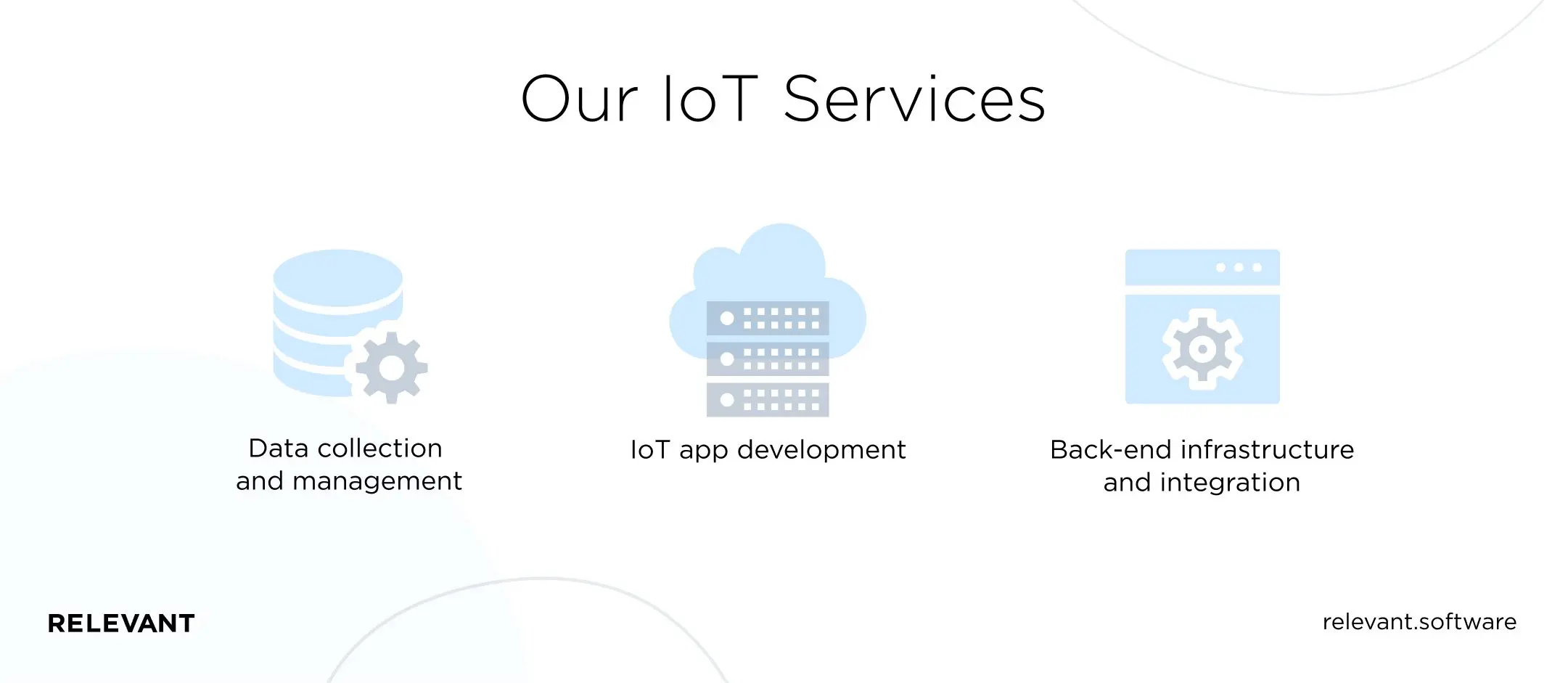
Relevant has deep expertise in IoT software solutions. We offer several IoT development services:
- Data collection and management. We build BI and reporting tools, ETL solutions, connectivity software, and IoT dashboards.
- IoT app development. We build iOS, Android, and hybrid apps, web apps, wearables connectivity, and mobile data visualization.
- Back-end infrastructure and integration. We develop cloud infrastructure to manage your IoT devices, including IoT cloud solutions, serverless architecture, ERP integration, and API development.
Smart Office IoT projects you should definitely outsource
Here are the specific types of projects we can help you with.
- Air quality monitoring software. One of the IoT solutions we develop is air monitoring apps. You can track temperature, noise, pollution, air pressure, and more. Depending on your setup, these apps alert you to poor air quality and suggest steps to fix it. The software we built for Airthings tracks multiple rooms and notifies users of less optimal air quality. It suits businesses of all sizes.
- Real estate management solutions. These solutions automate much of building management, including lease management, predictive maintenance, and compliance. Smart real estate software generates reports and tracks the performance of agents and buildings. For realtors and brokers, it manages the finances and operations of all properties in one place. Our real estate software development work covers real-estate ERP and CRM, mobile apps for real estate professionals, mortgage calculators, and custom dashboards.
- Moisture monitoring solutions. Water leaks and other conditions are hard to track by hand, and damage often shows up before anyone notices. With environmental tracking such as moisture monitoring apps, you catch abnormal moisture levels early. The smart water leak detection solution we built for Sensor Innovation detects moisture and rot early and warns users. Companies also get details on affected areas.
- Meeting room booking apps. Room booking apps keep meeting spaces used efficiently. Sensors track occupancy and sync with calendars and company data to show availability. You can view usage metrics like room capacity, hours in use, current bookings and cancellations, and available equipment. Our work here covers mobile apps, web apps, and third-party integrations.
Relevant can build these IoT smart office solutions and more for your company. Besides our development services, you can also hire an IoT developer with our help.
Additional resource: our guide on outsourcing to Ukraine.
Summary
Smart offices open real growth opportunities. From office automation with IoT to efficient energy use, companies gain value. You decide whether the benefits outweigh the concerns. Technology keeps advancing either way. Companies that adopt smart offices now can future-proof their business and gain a competitive edge.
If you need IoT smart office solutions for your company, contact Relevant. We can help with the IoT development services your project needs.


